
Questions, answered
Bringing a German Shepherd into your family is a long commitment, and good questions are a good sign. Here are honest, detailed answers to the ones we hear most — and if yours isn’t here, we’d rather you simply ask us.
Getting a puppy
What breeds do you raise?+
We selectively breed German Shepherd Dogs and Dutch Shepherds — chosen for intelligence, sound temperament and drive. We are a family kennel focused on healthy, well-started companions and working prospects; we do not breed for show, designer crosses, or looks alone.
How much do your puppies cost, and what’s included?+
Price varies with pairing, gender, coat, age, any head-start training and current demand — most of our puppies fall between $650 and $1,500. Every puppy goes home with a great deal more than the puppy:
- Full AKC registration application & pedigree
- Age-appropriate vaccinations (with records) and deworming every two weeks
- Microchip and complete health records
- A written 2-year genetic health guarantee
- Volhard Puppy Aptitude Test results
- Early socialization with children, cats and other dogs, plus noise desensitization
- Litter-box & beginning crate training
- A blanket carrying mom’s scent and a sample bag of premium puppy food
All sales are final. If you are ever unable to keep a puppy purchased from us, we will gladly take the puppy back within 30 days — though no monetary refund is issued.
Can I reserve a puppy, and how do deposits work?+
Yes — and we recommend it if you’re serious, because our litters typically sell out by 4–6 weeks of age, well before the puppies are ready to go home. A reservation deposit is $250, with the balance due at pickup. Deposits can be held up to a year and transferred to a future litter if your plans change.
What forms of payment do you accept? Do you offer payment plans?+
We accept cash, cashier’s check, money order, credit/debit card, Zelle, Apple Pay, Google Pay, ACH and Venmo. Card and online payments are handled securely through Stripe. Payment by check or money order means the puppy is held until funds clear (usually 2–3 business days).
We can also usually arrange payment plans — a common arrangement is $100/week until paid in full, at which point the puppy can go home. Larger or smaller weekly amounts can often be accommodated; email info@cvgsd.com to discuss.
Health & guarantees
Are your dogs and puppies AKC registered?+
Yes — all of our dogs and puppies are purebred, AKC-registered German Shepherds, and we are proud to be an AKC Breeder of Merit. Every puppy comes with a registration application so the new owner can register the puppy in their name and access the pedigree. Registration is optional (a small one-time fee), but AKC-registered puppies also receive 30 days of complimentary pet health insurance — handy for that first vet visit. Learn more about registering with the AKC →
What health testing and guarantee do you provide?+
We conduct comprehensive health testing on our breeding dogs, including OFA evaluation of hips and elbows and genetic screening, and choose pairings to minimise inherited risk. Every puppy is sold with a written 2-year genetic health guarantee and complete health records, and (for puppies that travel) a veterinary exam before travel.
Are German Shepherds prone to health problems?+
Like all purebreds, German Shepherds can be predisposed to certain conditions — but responsible breeding and good care greatly reduce the risk. The main ones to be aware of:
- Hip & elbow dysplasia — joint malformation; we breed OFA-evaluated dogs to minimise this.
- Degenerative myelopathy (DM) — a progressive spinal disease; genetic testing identifies carriers.
- Bloat (GDV) — a life-threatening stomach twist; feed smaller meals and avoid exercise right after eating.
- Exocrine pancreatic insufficiency (EPI) — a digestive enzyme disorder.
- Allergies & skin issues — food or environmental sensitivities in some dogs.
Health-tested parents, regular veterinary care, good nutrition, appropriate exercise and a healthy weight give your puppy the best possible start.
When should I spay or neuter my puppy?+
Current evidence favours waiting. A 2016 study in Veterinary Medicine and Science found a significantly higher rate of cranial cruciate ligament (CCL) tears in German Shepherds neutered before one year of age, and more urinary incontinence in females spayed before one year. For that reason we recommend waiting until your puppy is at least 12 months old before spaying or neutering — talk to your veterinarian about timing for your dog.
Are the puppies vaccinated and dewormed?+
Yes. Puppies are vaccinated at least twice before going home, using Durvet Canine Spectra 5/6 at 4 weeks and Spectra 10 at 8, 12 and 16 weeks — protecting against distemper, hepatitis, adenovirus, coronavirus, parainfluenza, parvovirus and leptospirosis. Full protection develops after the 4th dose, so limit outside exposure until your puppy has had at least the first three.
All puppies are also dewormed every two weeks (at 2, 4, 6 and 8 weeks) with Durvet Liquid Wormer 2X against round- and hookworms. Your puppy will need a rabies vaccine from a licensed veterinarian at 12+ weeks to be licensed in most areas. As with people, vaccines reduce risk rather than guarantee immunity — keep young puppies away from dog parks until fully vaccinated and about six months old.
Bringing your puppy home
Can I pick up my puppy? Do you ship or deliver?+
We love for families to visit and meet their puppy in person, and offer free local delivery within 50 miles of our location (usually Thursday–Sunday with 2–3 days’ notice).
Beyond that, we ship at cost anywhere in the U.S. or worldwide — with no added fees. Puppies fly as live-animal cargo into major airports that accept it (locally, San Francisco International / SFO). As an alternative we also work with ground pet-escort services, where an escort personally picks up your puppy and drives them to you, staying with them the whole way. Escort cost depends on distance and timing.
How do I prepare my home for a new puppy?+
Puppy-proof by removing hazards and setting up a calm, designated area with a crate and toys. A short shopping list before pickup:
- Food & water bowls — non-slip bases work best.
- Collar, ID tag & leash — an adjustable buckle nylon collar with your contact info.
- A correctly-sized crate — just big enough to stand, turn and lie down. Too large and a puppy will sleep in one end and soil the other, slowing house-training. A crate becomes a safe den and speeds housebreaking.
- Age-appropriate puppy food — formulated for dogs under one year (or a vet-guided homemade diet with supplements).
- Toys — mental stimulation matters; a treat-stuffable Kong keeps a puppy busy when you can’t play.
Feeding & nutrition
What should I feed my puppy?+
While with us, our puppies eat 4Health Large Breed Puppy dry food, supplemented with lean meats (chicken, beef) and joint-and-bone supplements. Any quality large-breed puppy formula is a good choice — the key is that it’s formulated for puppies under a year.
If you prefer a homemade, human-grade diet, that can be excellent too — just add the right vitamin and mineral supplements so nothing is missing. Equally important is knowing what not to feed. The chart below shows common human foods that are safe versus toxic for dogs:

How much and how often should I feed my puppy?+
Feed enough to fuel healthy growth and energy without carrying extra fat. Amount depends on age, activity level and the calorie density of your food (brands vary a lot). Use this as a general starting point and adjust to your puppy’s condition:
| Puppy age | Amount per feeding | Feedings / day |
|---|---|---|
| 2–3 months | ¼ – ½ cup | 4× |
| 3–6 months | ½ – 1 cup | 3× |
| 6–12 months | 1 – 1¼ cups | 2× |
| Over 12 months | 1¼ – 1¾ cups | 2× |
When do I switch from puppy food to adult food?+
Large breeds mature slowly, so German Shepherds benefit from puppy formula longer — usually transition between 12 and 18 months, once your dog has reached ~80–90% of adult size and growth has slowed. Change over gradually across 7–10 days (25% new food every couple of days) to avoid stomach upset, and choose a large-breed adult formula for appropriate joint-supporting nutrition.
Training & housebreaking
When should I start training, and what’s the timeline?+
Training starts the day your puppy comes home (around 8 weeks) — German Shepherds are highly intelligent and thrive on early, consistent, positive work:
- 8–10 wks: socialization, house rules, name recognition, potty training — very short (2–3 min) sessions.
- 10–12 wks: basic commands (sit, down, come) with positive reinforcement; gentle leash intro.
- 3–4 mo: build duration and impulse control; positive exposure to new places.
- 4–6 mo: structured 5–10 min sessions, 2–3× daily; keep socializing.
- 6 mo+: more advanced work and formal obedience classes.
Keep it positive and consistent — the foundation you build in the first year shapes a lifetime.
How do I potty train my puppy?+
German Shepherds house-train quickly with a routine. Take your puppy out first thing in the morning, after meals, naps and play, and before bed — young puppies need to go every 2–3 hours. Use the same spot and a cue like “go potty,” then reward the moment they finish outside. Supervise indoors, use a correctly-sized crate when you can’t watch (dogs avoid soiling where they sleep), and never punish accidents — clean with an enzymatic cleaner to remove the scent. Most puppies are reliably trained by 4–6 months. Our litters also arrive litter-box trained, which makes the transition easier.
What’s the best way to crate train?+
A crate gives your puppy a safe den and speeds housebreaking. Pick one just big enough to stand, turn and lie down (a divider grows with your puppy). Make it positive — comfy bedding, toys, meals near or inside, never punishment. Introduce it gradually with the door open and treats tossed in, then short closed sessions while you’re present. Use a cue like “kennel up,” keep the crate in your bedroom at first, and remember puppies can only hold their bladder about their age in months plus one hour. Most puppies settle within 2–4 weeks.
How do I stop my puppy from jumping on people?+
Address it early, before your Shepherd is full-sized. Be consistent (everyone follows the same rule), and ignore the jump — turn away, no eye contact or touch, and only give attention when all four paws are down. Teach an incompatible behaviour by rewarding a sit for greetings, and manage arrivals with a leash or gate until the excitement passes. Avoid kneeing or stepping on paws — that can create fear or feel like play. Most puppies improve within a few weeks with consistency.
Behavior & development
How do I socialize my puppy?+
The critical window is roughly 8–16 weeks — expose your puppy to varied people, places, sounds, surfaces and handling in a positive, controlled way. Introduce people of different ages and appearances, different environments and surfaces, and gently handle paws, ears and mouth to prepare for grooming and vet visits. Always pair new experiences with treats and praise, and avoid dog parks until vaccinations are complete (arrange playdates with healthy, vaccinated dogs instead). Never force a fearful puppy — socialization continues throughout life.
Why does my puppy bite and mouth so much?+
Mouthing is normal — from teething (3–6 months), exploring the world, littermate play, and the breed’s herding instinct. To manage it: provide and rotate chew toys, give a high-pitched “yelp” and briefly stop play when bitten, redirect to a toy, reward gentle mouths, and make sure your puppy gets enough exercise, stimulation and sleep. Never use physical corrections. Most puppies outgrow heavy biting by 6–8 months; if it seems truly aggressive, consult a trainer or behaviorist.
Do German Shepherds make good family pets?+
Absolutely — with training and socialization they thrive in families. They’re loyal and naturally protective (great watchdogs without being over-aggressive), highly intelligent and trainable, energetic enough for active families, and — when socialized from puppyhood — typically patient and gentle with children (always supervise young kids and dogs). For the best result, socialize early, train consistently as a whole family, provide plenty of exercise and mental work, and teach children to respect the dog’s space.
How much exercise does a puppy need, and how big will they get?+
Match exercise to age to protect developing joints: short 10–15 min play sessions at 8–12 weeks, building to 20–30 min walks twice daily by 3–6 months and up to an hour twice daily by 12–18 months. A useful rule: about 5 minutes of structured exercise per month of age. Mental work (training, puzzle toys) matters as much as physical.
Adults are a medium-large breed — males about 24–26″ and 75–90 lb, females about 22–24″ and 55–70 lb. They reach full height by 12–18 months and keep filling out until 2–3 years. Your puppy’s pedigree helps predict adult size.
When will my puppy’s ears stand up?+
It varies by puppy, but German Shepherd ears are usually fully erect between 4 and 7 months. Ears often perk up, flop again during teething (when jaw and ear muscles get a workout), then settle upright once teething finishes around 5–6 months. Nearly all Shepherds have fully erect ears by a year — if not, it’s worth a vet check.
How do I groom a German Shepherd, and how often should I bathe?+
Shepherds have a double coat. Brush 2–3 times a week (daily during spring/fall shedding) with an undercoat rake or slicker brush. Bathe only every 2–3 months or when genuinely dirty — over-bathing strips protective oils; use a mild, puppy-specific shampoo and rinse thoroughly. Trim nails every 3–4 weeks, check ears weekly, and start tooth-brushing early with dog toothpaste. Begin grooming young, keep it short and positive, and you’ll rarely need a professional groomer.
Our program
What is the Volhard Puppy Aptitude Test, and do you use it?+
The Volhard Puppy Aptitude Test (PAT) is a well-established set of short exercises — social attraction, following, restraint, social and elevation dominance, retrieving, and sensitivity to touch, sound and sight — that reveals a puppy’s natural temperament and trainability. Each response is scored, and the pattern helps match a puppy to the right home and training approach.
We perform the Volhard PAT on every puppy at 7 weeks of age and share the results with new families, so you understand your puppy’s natural tendencies from day one and can tailor training accordingly.
How are your puppies raised and socialized?+
Our puppies are raised underfoot in our family home — not in a kennel building — with round-the-clock care. Because we have children, cats and other dogs, our puppies are socialized from birth with people of all ages and other animals, and deliberately exposed to everyday sounds (vacuums, TV, doorbells) so they grow up confident and hard to startle. Litters are litter-box trained, and puppies past 12 weeks begin leash work and basic commands (sit, down, leave it, heel). It’s the foundation behind the temperament and structure we’re known for.
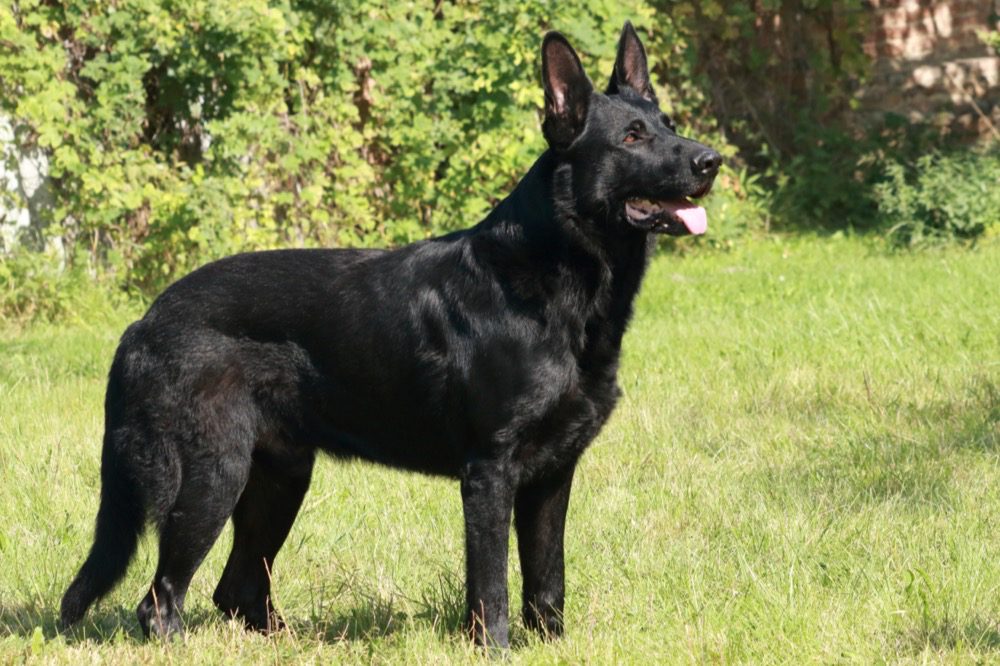
Ask us anything — we’re happy to help
More than two decades of raising German Shepherds means we’ve heard just about every question, and we’d rather talk it through than leave you guessing. Reach out and we’ll get you a straight answer.